5 Articles
Tags :microstructure-analysis

AZtecCrystal 4.0: Advanced EBSD Data Processing Software AZtecCrystal 4.0 is the latest generation of Oxford Instruments’ electron backscatter diffraction (EBSD) analysis software, designed for processing high-speed EBSD data from modern CMOS detectors . This version introduces three powerful new features that enhance researchers’ ability to evaluate and visualize complex EBSD datasets . Key New Features in Version 4.0 Crystal Batch (Batch Processing) Apply all of AZtecCrystal’s processing power to hundreds of map layers in a single operation . Ideal for 3D FIB slice analysis, in-situ experiments, quality control, and multi-sample workflows . External experimental parameters (temperature, load, extension) can be linked to synchronize EBSD metrics across multiple datasets . Crystal Compare (Data Stack Visualization) View and compare stacked datasets dynamically...
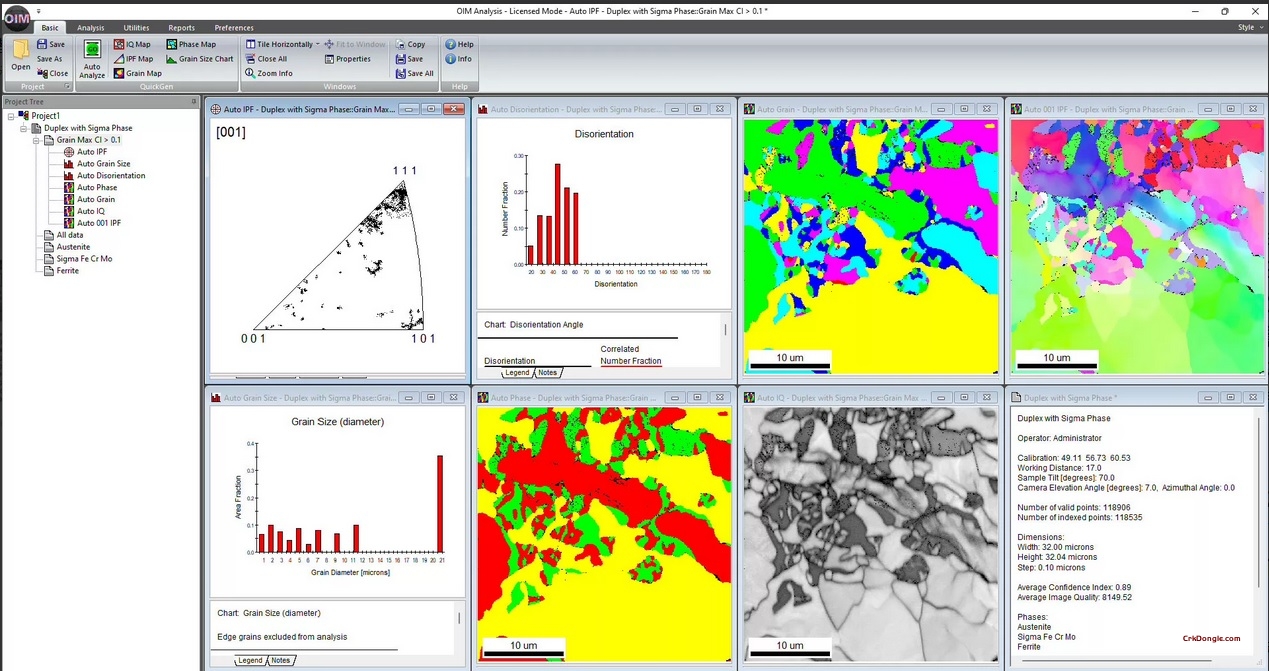
EDAX OIM Analysis 8.6 | Advanced Electron Backscatter Diffraction (EBSD) Data Analysis Software EDAX OIM Analysis 8.6 is a powerful software package for processing, analyzing, and visualizing crystallographic orientation and microstructural data obtained from Electron Backscatter Diffraction (EBSD) systems. It provides materials scientists with comprehensive tools for quantitative microstructural characterization. Core Functionality Overview: Comprehensive EBSD Data Processing: Features advanced tools for indexing diffraction patterns, cleaning orientation data, phase identification, and calculating microstructural parameters like grain size, texture (pole figures, ODF), and misorientation. Advanced Microstructural & Crystallographic Analysis: Includes specialized modules for analyzing deformation (kernel average misorientation – KAM), recrystallization, phase distribution, and correlative microscopy with EDS data. High-Quality Visualization & Reporting: Generates detailed maps (inverse pole figure, phase, band contrast),...
EDAX OIM Analysis 9.0 | Advanced Electron Backscatter Diffraction (EBSD) Data Analysis Software EDAX OIM Analysis 9.0 is a premier software package for processing, analyzing, and visualizing crystallographic orientation and microstructural data obtained from Electron Backscatter Diffraction (EBSD) systems. It provides materials scientists and metallurgists with comprehensive tools for quantitative microstructural characterization. Core Functionality Overview: Comprehensive EBSD Data Processing: Advanced tools for indexing diffraction patterns, cleaning orientation data, phase identification, and calculating microstructural parameters like grain size, texture (pole figures, ODF), and misorientation. Advanced Microstructural & Crystallographic Analysis: Features specialized modules for analyzing deformation (kernel average misorientation – KAM), recrystallization, phase distribution, and correlative microscopy with EDS data. High-Quality Visualization & Reporting: Generates detailed maps (IPF, phase, band contrast), charts,...
EDAX OIM Analysis 9.1: The Essential Software for EBSD Data Interpretation EDAX OIM Analysis 9.1 (Orientation Imaging Microscopy) is the dedicated analysis suite for processing, visualizing, and quantifying data acquired from Electron Backscatter Diffraction (EBSD) systems, primarily from EDAX/AMETEK. It is the critical software for materials scientists and metallurgists to transform raw diffraction patterns into comprehensive, quantitative maps of a material’s crystallographic microstructure. Core Function: From Diffraction Patterns to Crystallographic Maps The software’s primary role is to index the Kikuchi diffraction patterns captured by the EBSD detector at each point on a sample scan. It calculates the crystal orientation and phase at each point, compiling this data into detailed maps that reveal grain structure, texture (preferred orientation), and phase distribution....
MIPAR 5.3: Essential Software for Quantitative Microstructure Analysis MIPAR 5.3 is a specialized, user-driven image analysis software designed to extract precise, quantitative data from microscopy and scientific images. It empowers researchers and engineers, particularly in materials science, geology, and life sciences, to perform complex measurements on microstructures, particles, and features that are tedious or impossible to do manually. Core Function: From Image to Statistical Data Its primary function is to automate the identification, segmentation, and measurement of features within an image. Users create custom, step-by-step analysis “recipes” to consistently process batches of images, turning visual information into statistical datasets. Key Functions: Advanced Image Segmentation: Uses thresholding, watershed, and edge detection algorithms to accurately separate features of interest (grains, particles, pores)...