5 Articles
Tags :Optical Design Software

Sigmadyne SigFit 2026: Optomechanical Analysis & Coupling Software SigFit 2026 is Sigmadyne’s optomechanical analysis software for integrating finite element analysis (FEA) predictions with optical design software. The 2026 release includes two versions: 2026R1 and 2026R2 (the latest). Version 2026R2 introduces significant licensing changes and builds on the core optomechanical capabilities of the platform . Key New Features in 2026R2 Licensing Update New License Format: 2026R2 requires a new-format license file and license server software 11.19.9.0 . Transition for R1 Users: Version 2026R1 can run with either the old or new license format. Current customers received new _rev1 license files in June 2026, enabling a smooth transition . Core Modules Module Description Surface Fitting Fits Zernike, Annular Zernike, Aspheric, Forbes, and...
Synopsys CODE V 2026.03 is the latest release of the industry’s gold-standard optical design and analysis software. Trusted by optical engineers worldwide for over 50 years, it provides comprehensive modeling, optimization, tolerancing, and fabrication support for imaging systems, photonic devices, and free-space optics from the extreme UV to far-infrared wavelengths. What’s New in CODE V 2026.03 AI Start Expert AI Start Expert is a locally executed generative AI tool that quickly generates high-quality starting-point lens designs based on basic specifications such as field of view, effective focal length, and aperture. This dramatically accelerates the early design phase and enables rapid exploration of multiple design candidates. Accelerated Custom Tolerancing Enhanced tolerancing tools now support parallelized Monte Carlo analysis and multicolor tolerancing,...
Ansys Zemax OpticStudio v2026 Features and Capabilities Ansys Zemax OpticStudio v2026 (latest release as of early 2026, following patterns from 2025 R2 and prior updates) is the leading optical design and analysis software from Ansys, used globally for simulating, optimizing, and tolerancing imaging, illumination, laser, and photonic systems. This version builds on recent advancements in multiphysics integration, metalens design, productivity tools, and deeper Ansys ecosystem connectivity (e.g., with Ansys Speos for illumination, Ansys Lumerical for photonics, and Ansys optiSLang for optimization). OpticStudio supports sequential and non-sequential ray tracing, tolerancing, optimization, and analysis of complex optical systems—from lenses and mirrors to diffractive optics, freeform surfaces, and metasurfaces—ensuring high accuracy for real-world performance in aerospace, automotive lighting, consumer electronics, medical devices, and...
Ansys OpticStudio 2025R2 | Premier Optical System Design & Analysis Software Ansys OpticStudio 2025R2 is the industry-leading optical design and simulation software for developing advanced imaging, illumination, and laser systems. It provides a comprehensive environment for designing, optimizing, analyzing, and tolerancing optical systems from concept to manufacturable design. Core Functionality Overview: High-Fidelity Sequential & Non-Sequential Ray Tracing: Accurate modeling of imaging systems (lenses, telescopes) and complex non-imaging systems (light guides, backlights, stray light) using advanced ray tracing engines. Powerful Optimization & Tolerance Analysis: Robust global and local optimization algorithms for performance refinement, coupled with comprehensive tools to predict manufacturing yield through statistical tolerance analysis. Integrated Analysis & Interoperability: Extensive suite of built-in analyses (MTF, PSF, wavefront, polarization) and seamless data...
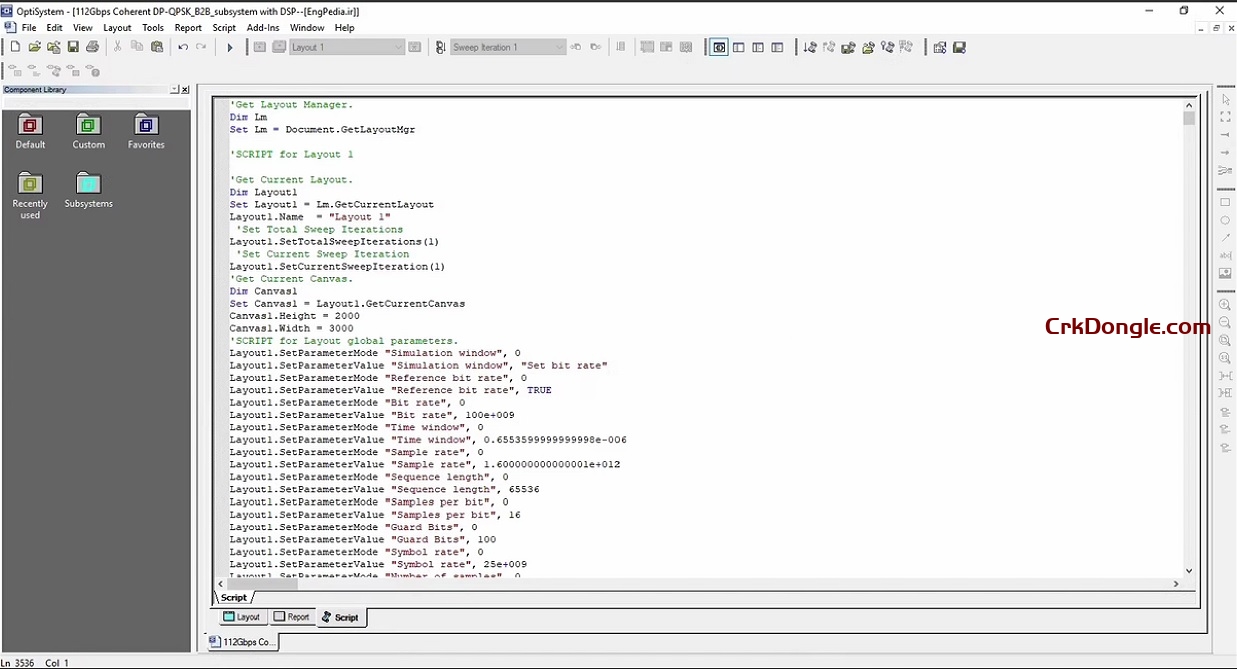
OptiSystem 23.0 | Advanced Photonic System & Optical Communication Design Software OptiSystem 23.0 is a comprehensive, powerful software tool for the design, simulation, and analysis of optical communication systems, fiber-optic networks, and photonic devices. It enables engineers and researchers to model complex optical links and validate system performance from the component to the network level. Core Functionality Overview: End-to-End System Simulation: Model complete optical transmission systems, including transmitters, fiber channels (SMF, DCF, etc.), amplifiers (EDFA, Raman), and receivers with realistic component libraries. Advanced Component & Network Analysis: Simulate and analyze the performance of key photonic devices (modulators, filters, detectors) and complex network architectures (WDM, PON, coherent systems) under various signal conditions. Integration with Measurement & CAD Tools: Features tools for...